
The VTech Hack: Ethan’s Code
based on the true event

In a small London apartment, the glow of a single desk lamp pushed back the dark outside. Ethan, just 21, sat hunched over his keyboard.
It was November 16, 2015. To him, the internet was both a safe space and a place to fight back. Ethan wasn’t the typical hacker out for trouble. During the day, he fixed computers at a local shop,
making broken devices work again. But at night, he explored the hidden corners of the web, angry at those who harmed the vulnerable. His latest focus was VTech, a toy company known for kid-friendly tablets that promised safe, connected play. Ethan’s little sister Lea loved her VTech tablet. He suspected their security was fake.
Growing up wasn’t easy for Ethan. He had seen how careless acts could break trust. Lea, now seven, was his anchor—a bright spot in his life. Hearing her giggle as she sent voice messages to their mom on her tablet made Ethan feel hopeful. But he knew the internet was dangerous. When he found out VTech’s tablets stored kids’ names, photos, and even voices, his protective side kicked in. If the company’s security was weak, Lea’s data, along with millions of others’, could be at risk. He targeted planetvtech.com, the main site for VTech’s Kid Connect. This was the tool that linked parents’ phones to their children’s tablets.
Ethan quickly searched for security flaws, looking for ways to access the site’s database. Using simple hacking tools, he found a small opening—an SQL injection flaw. The site crashed like a house of cards. Within minutes, Ethan had access to everything. It was like an open vault of data. “This can’t be right,” he whispered, feeling his heart race. “It’s too easy.”
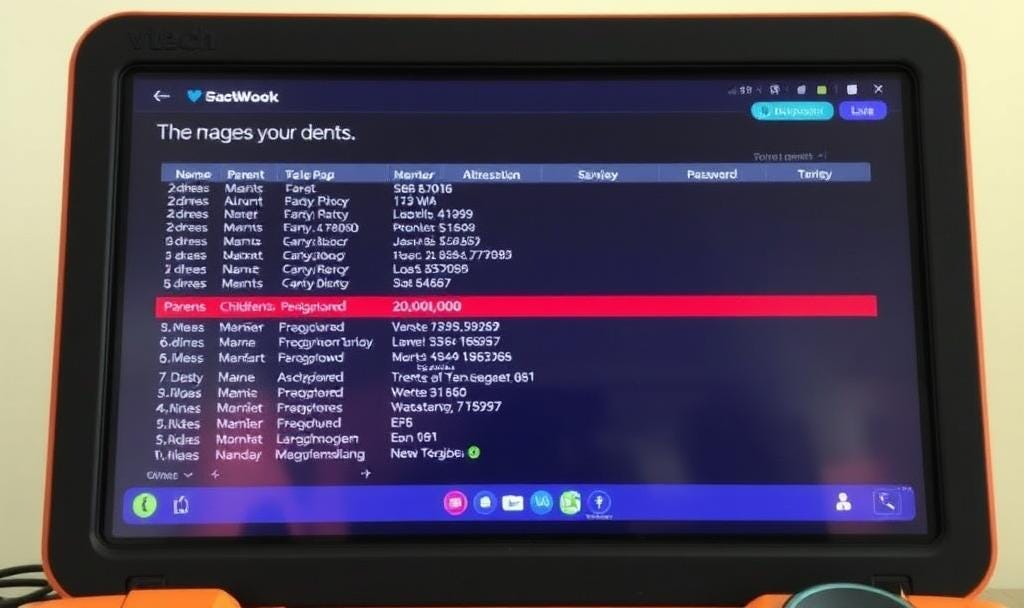
His screen showed data of 4.8 million parent accounts, with names, addresses, and weak passwords. There were also 200,000 children’s profiles—later updated to 6.3 million by VTech. The data included names, birthdays, and genders. Then Ethan saw the worst part: 190 gigabytes of photos, chat logs, and voice recordings of kids.
Many of these children were around five years old.
Ethan’s hands shook. He pictured Lea’s voice, her small selfies, floating on some hacker’s server. This was more than a breach; it was a violation of trust and innocence. Stealing the data and selling it on the dark web seemed tempting but made him feel sick. He saw himself differently—as a guardian, not a thief. His goal was to expose the company that played with kids’ security. “Someone has to make VTech listen,” he told himself. He refused to sell out. Protecting kids like Lea mattered most.
Ethan reached out secretly to Lorenzo, a reporter at Vice’s Motherboard. Using encrypted channels, he kept his identity hidden.
“I’m an ethical hacker,” Ethan typed. “VTech’s security is a mess. I got all this data—kids’ data—in just a few hours. Someone worse could do real harm. You need to make them fix this.”
His fingers paused, then he added, “It’s wrong that I could access this. VTech must be exposed.”
Lorenzo was cautious but interested. He shared the data with Troy Hunt, who runs HaveIBeenPwned.com. Troy examined the files and found serious flaws: passwords hashed with weak MD5, no HTTPS connection, outdated software. Troy asked his 300,000 subscribers to help verify. Parents confirmed their accounts, making the breach real.
The data was false alarm-proof. The news spread fast.
VTech’s team tried to ignore the problem at first. Then, after pressure from the media, they admitted an outsider had hacked into their systems on November 14. They shut down planetvtech.com and shut down other sites. Toys went offline, leaving parents angry and kids’s tablets useless.
Ethan watched this unfold with mixed feelings. He felt guilty but also determined. He sent more evidence to Lorenzo—photos, chats, recordings—and helped shape another story exposing the problem. The company’s stock fell 13 percent. Parents demanded answers. U.S. senators looked into child privacy laws. VTech hurried to fix their security, hiring FireEye to repair their systems by early 2016.
A class-action suit was filed in 2017, but it failed because no serious harm was proven. Ethan’s good intentions helped keep him out of trouble, and a judge later saw his actions as motivated by concern, not greed.
Ethan never sent the data to the dark web, a promise he kept quietly.
On December 15, 2015, police raided Ethan’s apartment. They arrested him for breaking the Computer Misuse Act. His equipment was taken, and his life was turned upside down. About a year later, VTech’s FAQ mentioned a “formal police caution” from November 2016.
It was a small note on a much bigger story.
Ethan disappeared into obscurity. People wondered if he was free or still haunted by what he had done.
A few months afterward, Lorenzo received a strange tip. VTech had a new line of smart home devices—light bulbs, cameras, and sensors—that claimed to be “secure.” But the tipster said their tests showed otherwise. The devices were just as vulnerable as their old tablets.
Lorenzo looked closer and found something shocking. Ethan had not acted alone.
A rival toy company had secretly hired him. They wanted Ethan to damage VTech’s reputation and stock, making room for their own products.
Ethan’s fight wasn’t purely about helping. It was part of a paid plan. His so-called “ethical” stance was just a cover.
As Lorenzo followed the clues, he found Ethan’s last move. Ethan had leaked the rival’s plan to the tipster. The act of rebellion tore Ethan’s employer’s scheme apart. For Ethan, protecting kids like Lea was more than just a job. It was personal.